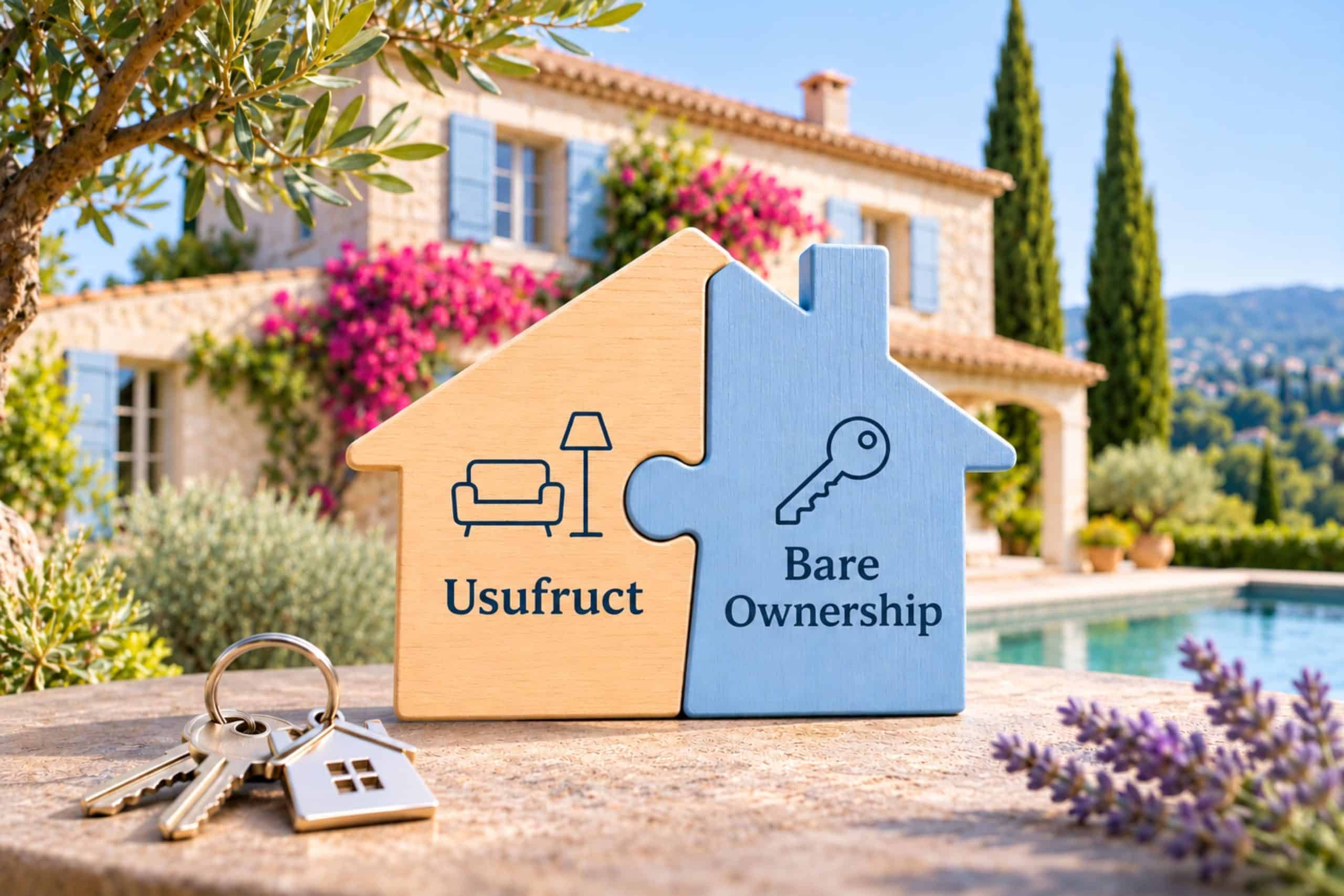



Splitting ownership — démembrement de propriété — divides full ownership of a property into two separate rights: usufruct and bare ownership. It is one of the most widely used tools for preparing an inheritance or reducing gift tax in France. Here is what each right covers, who pays for what, and how the value is divided.
In connection with a gift or to prepare an inheritance, you can choose to split the ownership of a property (démembrement de propriété). What is it? What obligations does it involve? Here is an overview.
| Right | What it gives | Who pays for what |
|---|---|---|
| Usufruct (usufruit) | The right to use and enjoy the property: to live in it or receive income from it | Maintenance, day-to-day repairs, property tax (taxe foncière) |
| Bare ownership (nue-propriété) | The right to dispose of the property, without the right to use it | Major repairs (grosses réparations) |
What does splitting ownership mean?
Splitting ownership consists of dividing the full ownership of a property into two separate rights:
- On the one hand, bare ownership (nue-propriété), i.e. the right to dispose of the property without having the right to use it.
- On the other hand, usufruct (usufruit), i.e. the right to use and enjoy the property. This means that you can live in the property or receive income from it.
Splitting ownership can be used in connection with an inheritance or a gift.
Full ownership consists of these two rights: usufruct and bare ownership. If you wish to sell the full ownership, the consent of both parties is therefore required. However, each party can sell their own right without the other’s consent.
Why split ownership?
Splitting ownership is often done in order to transfer real estate. It makes it possible, for example:
- to prepare the inheritance by giving the bare ownership to a child while retaining the usufruct,
- potentially to reduce gift tax, as it is calculated on the basis of the tax value of the bare ownership.
What are the obligations of the usufructuary and the bare owner?
The obligations differ for the usufructuary and the bare owner.
The usufructuary must in particular:
- maintain the property,
- carry out ordinary maintenance and day-to-day repairs,
- pay the property tax (taxe foncière).
The bare owner, for their part, must allow the usufructuary to use the property as they wish, and pay for major repairs (grosses réparations) in the case of real estate, unless these result from the usufructuary’s failure to maintain the property.
How is the value of the property divided between the usufructuary and the bare owner?
Where the usufruct is a so-called life usufruct, i.e. a usufruct that ends on the death of the usufructuary, the division of the property’s value is determined by a scale, depending on the usufructuary’s age.
| Age of the usufructuary | Value of the usufruct | Value of the bare ownership |
|---|---|---|
| Under 21 years old | 90% | 10% |
| Under 31 years old | 80% | 20% |
| Under 41 years old | 70% | 30% |
| Under 51 years old | 60% | 40% |
| Under 61 years old | 50% | 50% |
| Under 71 years old | 40% | 60% |
| Under 81 years old | 30% | 70% |
| Under 91 years old | 20% | 80% |
| Over 91 years old | 10% | 90% |
This scale is thus used to calculate registration duties (droits d’enregistrement) on a gift or an inheritance, or to apportion the sale price.
A simulator is available to calculate the tax value of a usufruct and of bare ownership.
Good to know. A temporary usufruct (usufruit temporaire), i.e. a usufruct for a fixed term, is valued for tax purposes at 23% of the value of the full ownership for each period of 10 years.
How does the usufruct come to an end?
The usufruct may end on the death of the usufructuary. The bare owner then becomes the sole owner of the property. They can live in it, let it or sell it.
The usufruct may also end when the stated period expires, where it was established for a fixed period.
Kind regards
Camilla Nissen MICHELIS
Cabinet Nicolas BRAHIN
Lawyers in NICE
1, Rue Louis Gassin – 06300 NICE (FRANCE)
Tel : +33 493 830 876
Fax : +33 493 181 437
Email : camilla.nissen.michelis@brahin-avocats.com
www.brahin-avocats.com